
Resettlement Vision 2030
DESIGN STRATEGY | RESEARCH | SYSTEMS THINKING
Client
Ministry of Justice
April 2023 - July 2024
Location • United Kingdom
Context
In 2021, almost 80 percent of crime was committed by someone who had offended previously. The Ministry of Justice (MoJ) has estimated that reoffending costs society approximately £22.7 billion a year.
Brief
Developing an actionable vision and long term ambition for what effective resettlement should look like for people inside and outside prison by 2030.
Considering the complexities of the Criminal Justice System with an initial set of potential opportunities to be explored further.
Approach
As the first service designer embedded within a policy team at the Ministry of Justice, I worked at the intersection of design, research and policy to make the Criminal Justice System visible enough to act on.
The work combined systems thinking with service design to understand the current system, identify opportunities for change and create the conditions for long-term transformation. The diagram below illustrates the approach, methods and outputs developed throughout the project.
Make sense
Explore the current system
–Research with people inside and outside prison
–Stakeholder engagement across MoJ and HMPPS
–Systems mapping to uncover patterns, structures and dynamics
–Identify opportunities for change
Create direction
Define a future state
–Develop a shared ambition for effective resettlement by 2030
–Create a vision, principles and outcomes framework
–Identify opportunities to move the system towards the desired future
Connect activity
Align strategy and action
–Map existing strategies, programmes and interventions
–Identify alignment, gaps and opportunities for greater coherence
–Analyse leverage points where change could have the greatest impact
Enable action
Create the conditions for change
–Develop a delivery model for tackling complex challenges
–Bring teams together around shared opportunity areas
–Embed test-and-learn approaches through research, prototyping and evaluation
Making complexity actionable
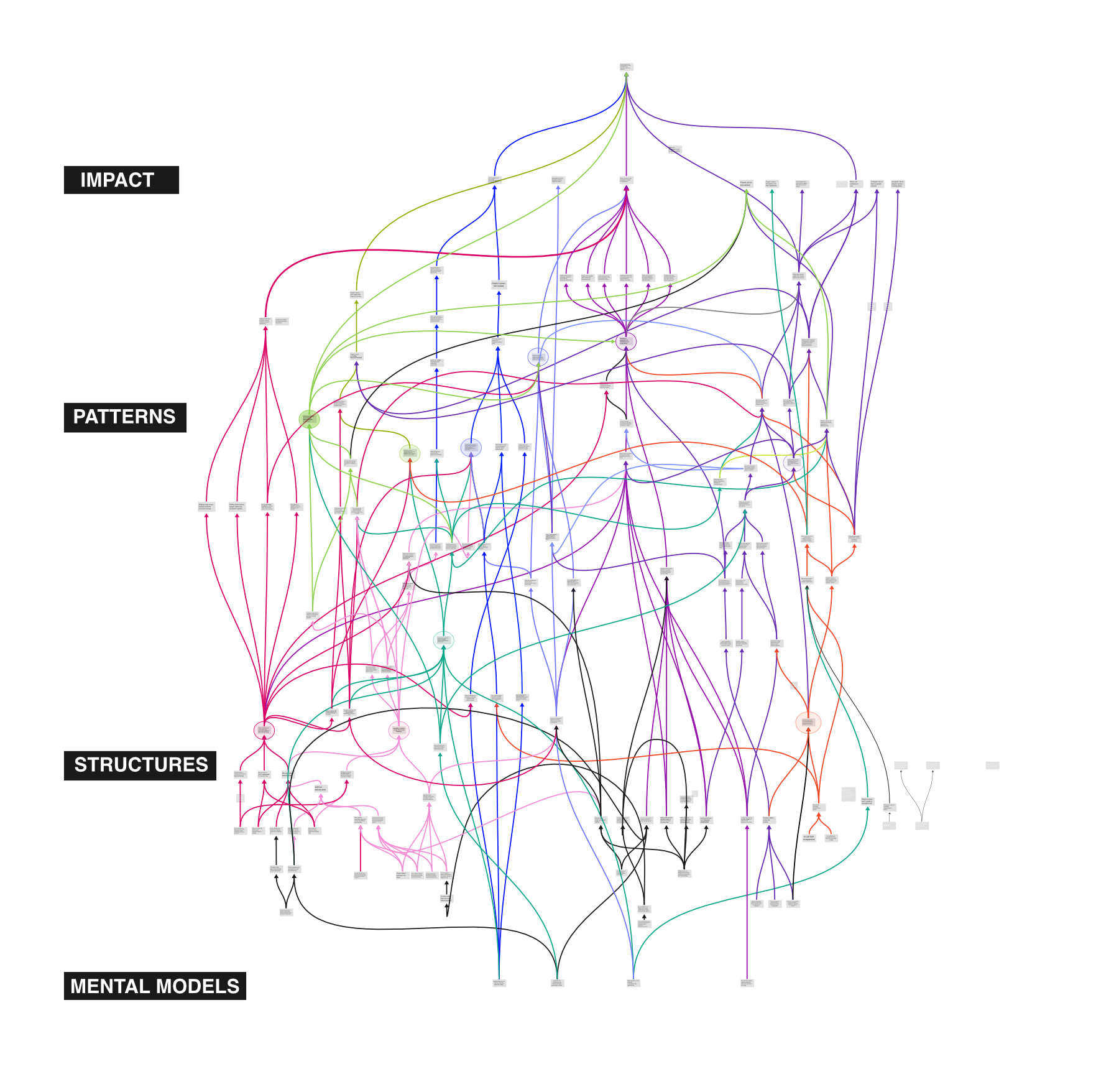
From mapping complexity to identifying opportunities for change
Over two years, I co-led the synthesis of qualitative and quantitative research to map the resettlement system in its entirety. The centrepiece of this work was a systems map — the first time the organisation had a visual representation of the full complexity of resettlement, showing the structural dynamics, dependencies and unintended consequences that sit beneath the day-to-day patterns policy tends to focus on.
The map evolved from making the complexity of the resettlement system visible, to identifying underlying dynamics and interdependencies, and ultimately to pinpointing opportunity areas and leverage points for intervention.
It became the foundation for the 2030 Resettlement Vision, shifting the conversation from isolated interventions towards system-level choices. The outputs were used by Civil Service Directors to brief incoming Ministers, and the systemic design approach was recognised with the Service Design Network Global Award 2023.
Understanding where interventions create change
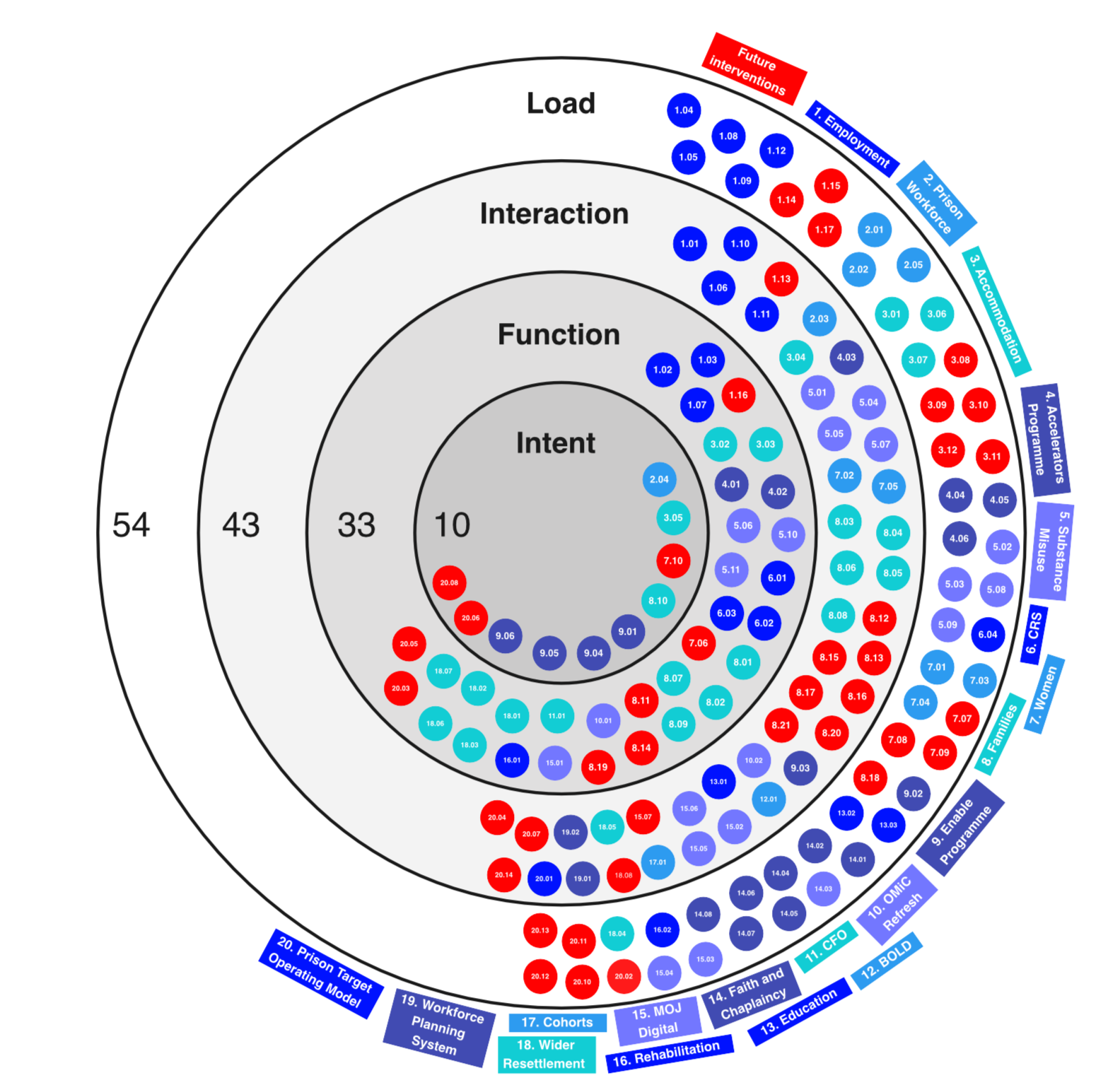
Moving beyond activity mapping to assess systemic impact
Existing interventions were assessed according to the level at which they influence the resettlement system: from System Load, which adds activity or complexity; through Systemic Interaction, which changes how activities connect; to System Function, which changes how the system operates; and System Intent, which shifts its underlying purpose or approach.
This analysis moved beyond simply counting initiatives to assess whether activity was contributing coherently towards the desired system change. It highlighted where interventions were influencing the system’s intent and function, and whether activity at the interaction and load levels was reinforcing a shared direction rather than adding disconnected activity and complexity.
Creating the conditions for change
Approach to delivery
I developed a proposed delivery model that brought together 41 opportunity areas into eight cross-cutting workstreams, connecting existing teams with policy, operational, service design and user research capabilities.
Connector teams would coordinate these networks, creating shared ownership across teams working towards the same outcomes. Grounded in a test-and-learn approach, the model used research, experimentation and evidence to develop and test interventions before committing significant resources to implementation and scale.
The approach aimed to shift investment from isolated projects towards long-term capability, while making better use of existing resources and creating a continuous cycle of learning and improvement. Despite strong interest from senior leaders, organisational constraints meant the model was not taken forward (a reminder that making the case for systems change is rarely straightforward, even when the insight is there!).